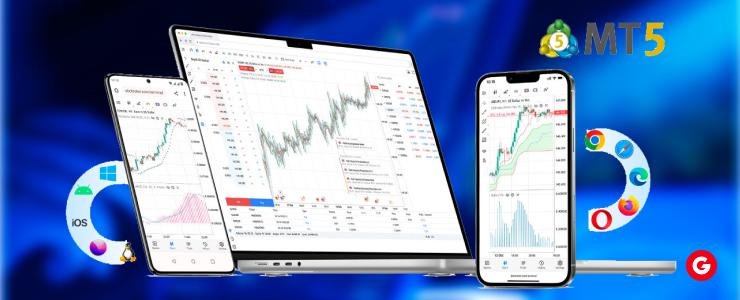
The distinction between retail and institutional trading has always been partly a matter of access. Institutional desks at Singapore’s major banks and asset managers have operated with analytical infrastructure, execution capabilities, and data resources that retail participants could observe from a distance but rarely approximate in practice. That gap has not closed entirely, and pretending otherwise would misrepresent what retail trading actually involves. What has changed is that certain tools once confined to professional environments have become available to self-directed traders through platforms that sit within reach of anyone with a funded account and the discipline to use them properly. MT5 represents the most significant example of that shift for Singapore’s independent trading community.
The depth of the platform’s analytical environment is what experienced practitioners point to first. Access to multiple timeframes simultaneously, a comprehensive library of built-in indicators, and the ability to run custom analytical tools developed in MQL5 creates a research environment that would have required dedicated software and significant expense to replicate a decade ago. Singapore traders who came up through earlier platform generations describe the transition to MT5 as genuinely expanding what they could see in the market, not just displaying familiar information more attractively but revealing relationships and patterns that simpler tools had obscured.
The multi-asset capability carries particular significance for Singapore’s increasingly sophisticated retail participants. Currency pairs, global indices, commodities, and equities can be monitored, analyzed, and traded within a single environment, which supports the kind of cross-market thinking that professional traders apply routinely. A self-directed trader watching how gold responds to dollar weakness while simultaneously managing a currency position and monitoring equity index behavior is doing something that institutional desks have always done but that retail participants previously had to approximate through multiple disconnected tools. The integration the platform provides makes that multi-asset awareness practically manageable rather than theoretically possible.
Depth of market functionality has attracted Singapore traders who want visibility into order flow beyond the single price stream that simpler platforms provide. Understanding where liquidity sits at different price levels, and how that distribution shifts during different market conditions, adds a dimension to trade planning that purely indicator-based analysis cannot supply. Professional traders have incorporated order flow analysis into their practice for years. The availability of similar functionality within a retail platform environment has given Singapore’s more analytically ambitious self-directed traders a tool that genuinely bridges some of the institutional gap.
The automated trading environment within the platform has developed a dedicated following among Singapore’s technically capable retail community. Expert Advisors running on the platform can execute strategies across multiple instruments simultaneously, applying consistent logic at speeds and with a discipline that manual trading cannot match. The quality of the backtesting infrastructure, discussed extensively in Singapore’s algorithmic trading circles, means that automated strategies can be stress-tested against historical data with a rigor that inspires genuine confidence rather than false certainty. Traders who have built and validated systematic approaches through the platform describe a fundamentally different relationship with their strategies than those relying on discretionary judgment alone.
What MT5 has done for Singapore’s self-directed trading community is shift the practical ceiling of what individual participants can accomplish. The tools are available. The education to use them well is increasingly accessible through the city’s active trading ecosystem. Whether individual traders rise to meet the capability the platform offers depends, as it always has, on the quality of the thinking they bring to it rather than the sophistication of the instrument itself.