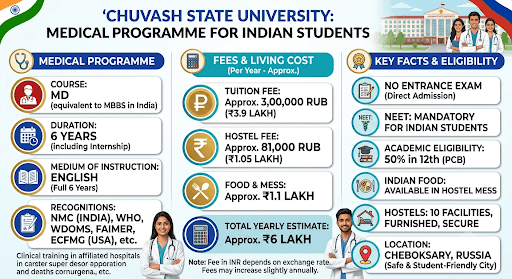
Russia has a wide range of institutions offering MBBS-equivalent programmes for international students. Not all of them are standalone medical universities. Chuvash State University, located in Cheboksary, the capital of the Chuvash Republic, is a public university established in 1967. It operates a medical faculty within a larger multi-disciplinary university structure. This article covers what Indian students should know about its medical programme, fees, recognition, and ground realities.
A Comprehensive University, Not Just a Medical Institution
This is an important point that students often miss. Chuvash State University is not a dedicated medical university. It has 115 departments across its campus and four faculties dedicated to medical studies. The university is formally named after educator Ilya Nikolaevich Ulyanov. Its medical institute functions as one part of a larger academic institution that spans engineering, law, economics, and other disciplines. For students, this means a more diverse campus environment but also a different institutional character compared to universities built exclusively around medical education.
One Distinctive Feature Worth Noting
The university houses the biggest anatomy museum in the Cheboksary region, with more than 700 original organs and human bodies available for practical study. For medical students, practical anatomy exposure is a meaningful part of training. This is one of the more concrete differentiators the university offers compared to other regional institutions.
Recognition Status
The university is recognised by the National Medical Commission (NMC) of India, the World Health Organization (WHO), and other global medical bodies, with its medical faculty operating under accreditation from the Russian Ministry of Education and Science at Level IV status. It is also listed in the World Directory of Medical Schools (WDOMS) and holds recognition from ECFMG and FAIMER. This recognition profile covers the basic approvals Indian students need to remain eligible for India’s licensing exam after graduation. Statuses are reviewed periodically. Students should verify the current NMC list directly before applying.
Course Structure and Duration
The MBBS-equivalent programme runs for six years. The first five years cover academic and clinical coursework. The sixth year is dedicated to internship-based training. Instruction for international students is conducted in English for the full course duration. Russian language training is provided alongside, primarily to support patient interaction during hospital rotations in later years. The university has 39 clinical training bases affiliated to it, giving students access to practical exposure across multiple hospital settings.
Fees: What the Numbers Look Like
Fee figures published across different websites for this university vary considerably. This is partly because some sources quote figures for the general university, others for the medical faculty specifically, and most omit hostel and living costs entirely. One consolidated estimate puts the tuition and hostel cost combined across six years at approximately Rs. 14 to 18 lakh, with total all-inclusive costs rising further once food, insurance, and administrative expenses are added. Students should always ask for a complete, itemised fee breakdown — covering every year of tuition, hostel, medical insurance, visa extension, and living costs — before making any financial comparison. A tuition-only figure is not a reliable basis for budgeting a six-year programme abroad.
Hostel and Daily Life
The university has 10 hostels on campus, providing hot and cold water, 24-hour gas and electricity supply, and basic furnished rooms. Indian food is available in hostel canteens. The university campus has sports facilities and hosts cultural programmes including Indian festivals. Cheboksary is a smaller city, which generally means lower daily living costs but fewer big-city amenities compared to Moscow or St. Petersburg.
Location and Safety Context
Cheboksary is located in Russia’s interior, well away from the western border areas that have drawn concern due to the ongoing Russia-Ukraine conflict. Universities in Russia’s interior, including those in the Chuvash Republic, have been classified as carrying the lowest conflict-related risk for international students, with no reported disruption to academic operations. Students should nonetheless check the current advisory from the Indian Embassy in Moscow before finalising any decision.
FMGE: The Honest Picture
After completing MBBS in Russia, Indian students must clear the FMGE or NExT exam to obtain a medical licence in India. University-specific FMGE data for this institution is not widely available from verified official sources. Nationally, the FMGE December 2024 session recorded a pass rate of 29.62%, while June 2024 was 20.89%. Pass rates vary significantly by institution within this national range. Students should request year-wise, verified FMGE performance data from the National Board of Examinations report or from alumni who have appeared for the exam — not from admission consultancy websites. The gap between official data and marketing claims can be substantial, as noted in earlier analysis of other Russian universities.
One More Point to Check
Students who enrolled in Russian universities between 2020 and 2022 and attended online classes during the COVID period should note that NMC introduced a rule in March 2026 requiring “compensation training” for those semesters to count. This applies across several countries, including Russia. Any student in this batch window should confirm in writing with their university whether compensation training applies to them. This is relevant for families with students already enrolled, not just new applicants.
Final Word
Chuvash State University offers an affordable entry point into MBBS in Russia for Indian students, with genuine strengths in anatomy infrastructure, full English-medium instruction, and multiple clinical training affiliations. Students considering it should go in with clear eyes — verify current recognition status, get an all-inclusive six-year cost breakdown, and source FMGE outcomes from official data. The right decision starts with complete information.


